

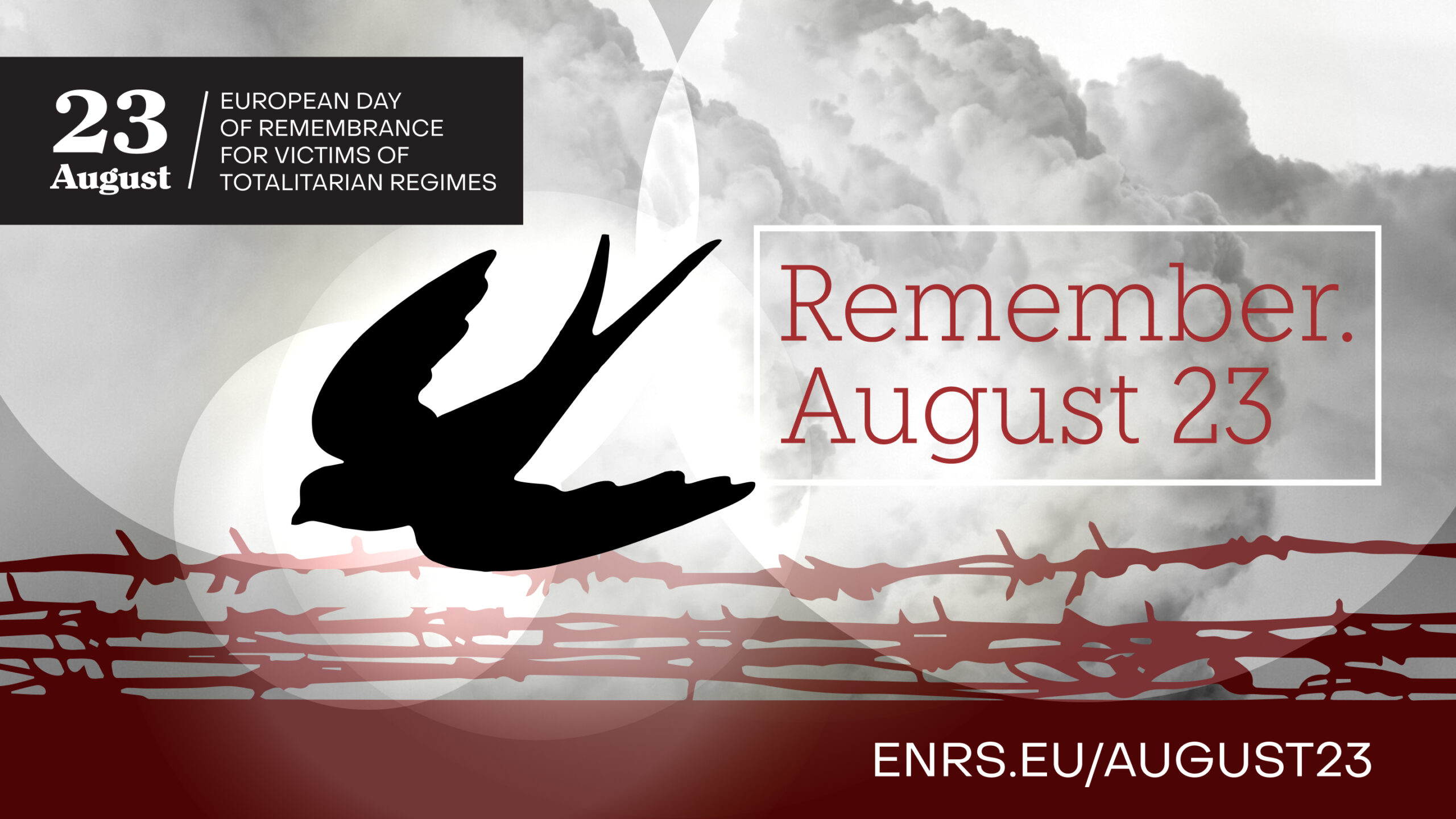
Established by the European Parliament in 2009, the European Day of Remembrance for the Victims of All Totalitarian and Authoritarian Regimes is observed on 23 August. To mark the occasion, the European Network for Remembrance and Solidarity (ENRS) is launching the thirteenth edition of its «Remember. 23 August» campaign, a public awareness initiative that explores the crimes of Nazism and Communism, as well as their enduring significance for Europeans today.
This date commemorates the Molotov–Ribbentrop Pact, signed on 23 August 1939. On paper, it was a non-aggression pact; in reality, its secret protocol divided Central and Eastern Europe between Nazi Germany and the Soviet Union, paving the way for the Second World War. What followed — concentration camps, Soviet gulags, the Holocaust, decades of oppression — still shapes the region today and continues to resonate through family histories.
This year is dedicated to Dr Stefania Perzanowska, a doctor who, in January 1943, set up a hospital within the German concentration camp at Majdanek, thereby saving the lives of her fellow prisoners despite having virtually no medical equipment or medicines at her disposal. At the time, she was unaware that her husband, Dr Zygmunt Perzanowski, also a doctor, had already been dead for nearly three years, having been murdered whilst in Soviet captivity as one of the victims of the Katyn massacre.
«The story of Stefania and Zygmunt Perzanowski reveals an aspect often overlooked in accounts of the Second World War: that Nazi Germany and the Soviet Union, despite their different methods of terror, devastated the same families — sometimes simultaneously, from opposite directions. Without understanding what happened on 23 August 1939, and all that followed from it, it is difficult to grasp not only the history of the 20th century, but also why so many of these stories remained unknown for decades. In an era marked by disinformation and increasing attempts to obscure responsibility for these crimes, remembering lives such as theirs is no longer merely a duty to the past. «In the shadow of the war in Ukraine, this has now become part of how societies build their resilience in the face of the distortion of history,» explains Rafał Rogulski, director of the ENRS.

 French
  English
  German
  Spanish
  Italian
  Portuguese
  Polish
  Ukrainian